
Weekly Management: SWAP in Action
Welcome to the Weekly Management Series 🎯
We built this for the planners, the list-makers, and the Type A's who live for an empty inbox. In this series, we’ll explore:
The SWAP Standard: Why we prioritize weekly management and how we stay accountable.
SWAP in Action: A look at how we manage our projects currently in flight.
SWAP Feature Spotlights: The specific tools within SWAP PM that help you get down to the details.
Part Two: SWAP in Action
Welcome back! You've already seen why weekly accountability check-ins are a game-changer in last week's post. Check that out here if you missed it!
Now let's explore what these look like in practice.
We've deployed this system across every level of the industry: from high-level sessions with clients and core design teams to granular internal task tracking for architecture firms. We even drop into design coordination calls to nail down specific due-outs. Wherever the work is happening, we're there to make the accountability magic happen.
The feedback from owners has been clear: they love being part of these sessions. It replaces the usual guesswork with total clarity, ensuring they know exactly what's being accomplished and exactly who needs answers from them.
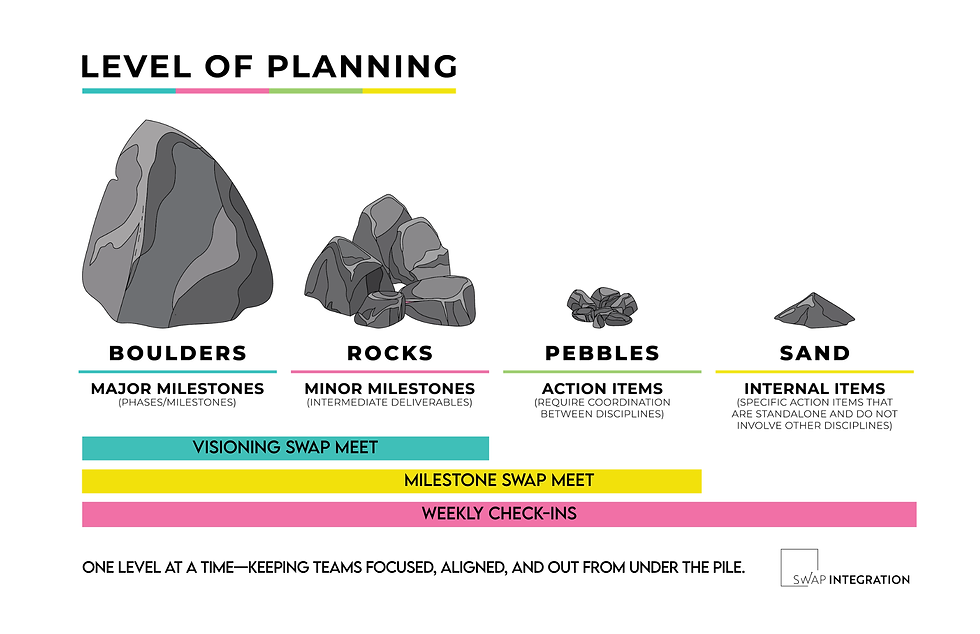
Let's lay the groundwork for this meeting by doing a quick recap on our levels of planning: Boulders > Rocks > Pebbles > Sand.
The Boulders represent project milestones (think 50% DD or 75% CDs). We discuss Boulders at the Visioning session when we kick-off a project.
The Rocks represent secondary milestones or an important hand-off of information (think architectural model freeze or a client presentation where direction is required). These are also discussed in our Visioning session.
The Pebbles represent inter-disciplinary coordination (such as the mechanical engineer sending equipment cut sheets and weights over to structural). This is the level of detail we get into during our weekly accountability meeting.
The Sand represents smaller, company-specific action items (such as an architecture teammate annotating a specific detail for a deliverable). BONUS: Sometimes we have a separate check-in with just the architecture team to discuss Sand (specifically, who is doing what and when).
So how do these check-ins actually work?
We kick off every meeting by reflecting on the past week: what crossed the finish line and what fell short? For the tasks that slipped, we don't just dwell - we immediately identify the new deadline and assess the ripple effect on the rest of the team.
From there, we look two weeks ahead starting with critical items (Boulders and Rocks) before moving to the calendar. We evaluate upcoming meetings, fine-tune agendas, and identify any missing touch-points that could cause friction later.
Finally, we go lane-by-lane, giving every company and discipline the floor to:
outline their upcoming focus
request additional coordination,
or flag any roadblocks.
By creating this dedicated space for teams to ask for what they need, we move from a culture of reactive troubleshooting to one of proactive problem-solving.
Most teams are meeting every week.
Very few are actually managing anything.
Next week, we’ll show you how SWAP PM turns this into a system.
xo The SWAP Team


Comments